The original fabric on the State Department Sofa.
When Chris first approached us about the possibility of embossing a pattern from the State Department Sofa we were excited, a little bit apprehensive but full of enthusiasm. Unfortunately the first photos that we received of the fabric were not of the highest quality but with hard work and diligence we were able to start and extract a design. None of this would have been possible without the highly skilled expertise of my two colleagues, Alison Pyott and Zoe Sheehan Saldana, who transformed an almost illegible photo into a workable design.
The first thing Alison did was to blow up the photos and then meticulously trace around the design so that we could send a clearer picture for Zoe to scan in the computer.
Zoe starting to extract the key elements of the pattern from the design.
Zoe and Alison conferring about the pattern.
After the design was scanned into the computer Zoe worked up the key elements and then printed them out in multiples so that she and Alison could begin to form the layout.
The main elements of the design laid out in the size of the pattern repeat.
The next step was to add the secondary designs and start to tie it all together.
Alison and Zoe fine tuning the pattern repeat.
The final draft printed out to scale with a sample plate of the "pomegranate".
The finished plate ready for embossing this coming week! Stay tuned for the first run through.
Friday, February 24, 2012
Monday, February 6, 2012
The Chris Rebollo Sofa ~ Step 2: Building the Warp
| The first thing that we do after dyeing is weave a small sample to check how the dyed colors look woven up. |
Once the color is approved in the woven sample we can then forge ahead with making the warp.
Here is Lynnette winding spools from the dyed skeins using an umbrella swift and a walking wheel.
| There were thirty five skeins of dyed yarn so we ended up with thirty five spools to make the warp. Here are the spools set up on the skarne (spool rack) ready to start. |
For this project we needed a 30 yard warp, 32" wide with 48 threads per inch. The total amount of
dyed yarn was 9 pounds. It took over six hours to make this warp, start to finish.
Here it is all chained up!
The loom that we are using for this project is a documented 18th c. loom from Connecticut.
This step of winding on the warp is called "beaming" because the warp is wound onto the large back beam at the rear of the loom.
The warp at the beginning stage of winding onto the back beam.
The warp all beamed on showing the raddle which spaced the warp at the correct width.
Monday, January 23, 2012
Projects for 2012.....The Philadelphia Sofa of Christopher Rebollo
Our first project of the new year is to weave a canary yellow embossed harateen for this incredible 18th
sofa frame belonging to Chris Rebollo of Christopher Rebollo Antiques. The frame was made in Philadelphia in the 1780's and is similar to another Philadelphia sofa in the collection of the US State Department.
When Chris discovered fragments of the original fabric under the early nail heads of his frame...which were a brilliant yellow....he was inspired to find a fabric that would be as close as possible to the fabric on the State Department Sofa. That's where we come in!
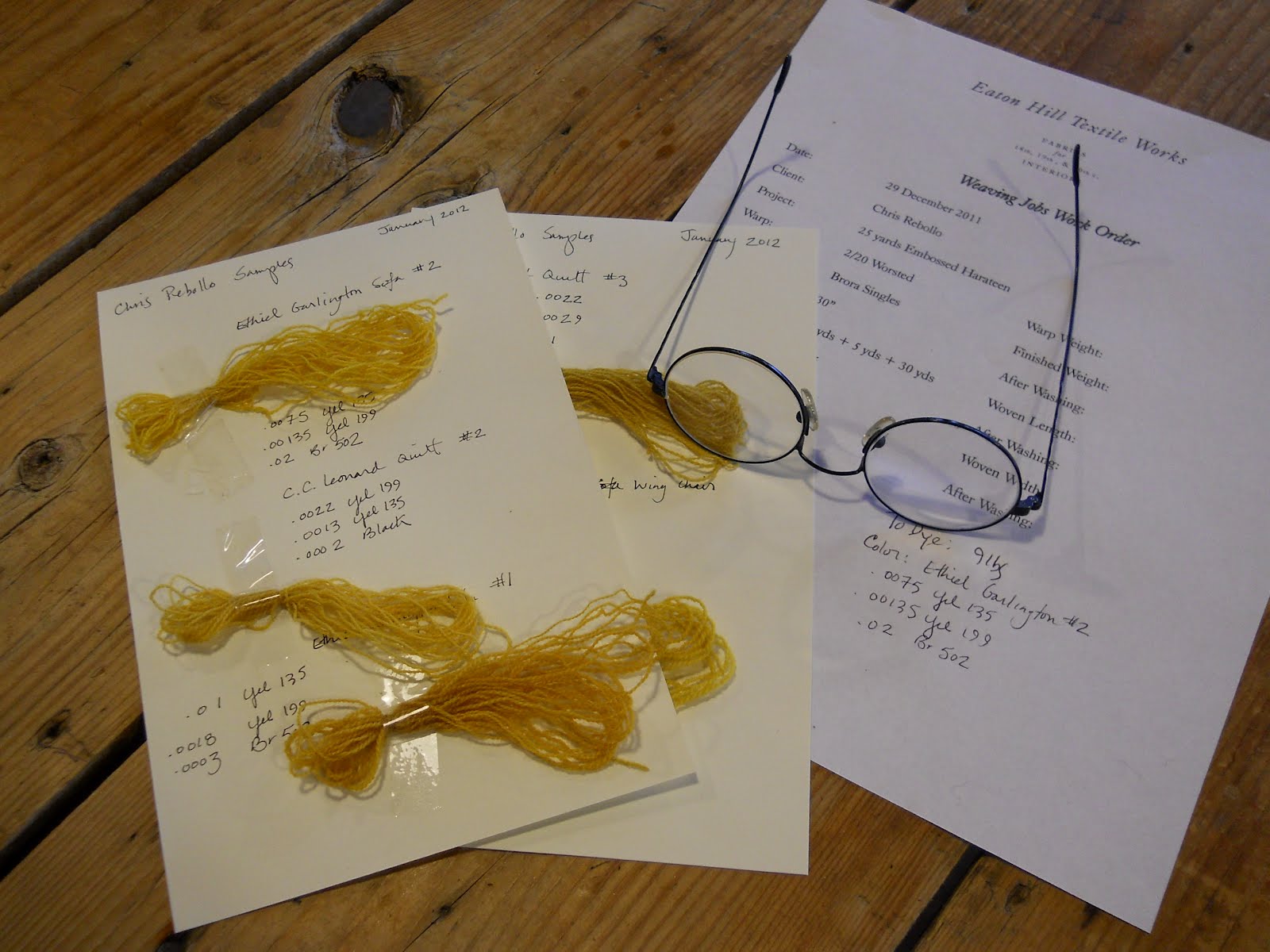
Step 1: Getting the color. The first thing that we do on our end is to start with some color samples of yellows that we have dyed for other projects and to see if any of them are close to what Chris had in mind. Of the
six samples that were sent, one was very close so that was a place to begin.
The yarn that we will dye for this fabric is a high quality 2 ply worsted wool and is as close as we can get to
what would have been used on the original piece.
Making the 40 skeins of worsted yarn to be dyed using a custom made skein winder.
Skeined yarn before dyeing.
Ready for the dye pot.

The finished yarn.
sofa frame belonging to Chris Rebollo of Christopher Rebollo Antiques. The frame was made in Philadelphia in the 1780's and is similar to another Philadelphia sofa in the collection of the US State Department.
When Chris discovered fragments of the original fabric under the early nail heads of his frame...which were a brilliant yellow....he was inspired to find a fabric that would be as close as possible to the fabric on the State Department Sofa. That's where we come in!
Step 1: Getting the color. The first thing that we do on our end is to start with some color samples of yellows that we have dyed for other projects and to see if any of them are close to what Chris had in mind. Of the
six samples that were sent, one was very close so that was a place to begin.
The yarn that we will dye for this fabric is a high quality 2 ply worsted wool and is as close as we can get to
what would have been used on the original piece.
Making the 40 skeins of worsted yarn to be dyed using a custom made skein winder.
Skeined yarn before dyeing.
Ready for the dye pot.
The finished yarn.
Subscribe to:
Posts (Atom)